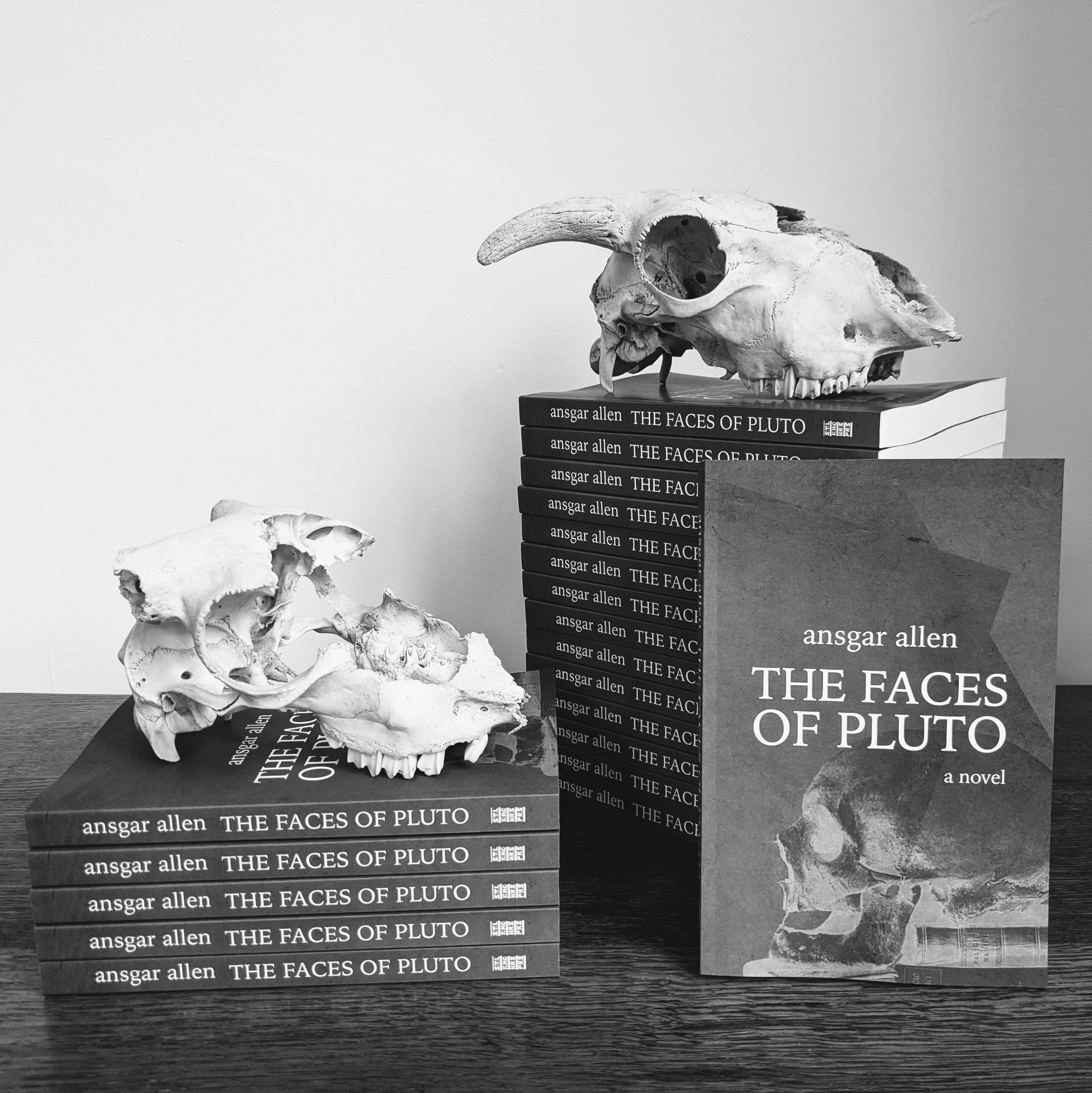
The Faces of Pluto
2024 Stalking Horse Press.
Available via Amazon, Barnes & Noble, Blackwells & Waterstones & others.
Excerpts published in Futch Journal: ‘Hostius Quadra and his mirrors‘, Cephalophore #2 ‘The man in the burrow‘, and on Substack, ‘3,000 Years of Deception‘.
“A book which effaces more than two thousand years of humanism with corrosive pleasure and without success. Relishing that failure, devouring it, sucking the juice from the bone.” — Emile Bojesen
“Who is to say that an orderly mind is more fertile than, and thus superior to, a feral one?” — S.D. Stewart
REVIEWS
Henry Simmons, Verdigris, 2 June 2025; Louis Armand, Erratum Reviews, 31 Jan 2025; S.D. Stewart, Heavy Feather Review, 28 Jan 2025.
Author interview by S.D. Stewart, Heavy Feather Review, 18 February 2025.
BOOK DESCRIPTION
Books are read in an instant and by a single eye. Libraries can no longer burn, they are already in the air. There is nothing left for admirers of truth or accuracy but submission to the absolute, unalterable veracity of the word.
The Faces of Pluto remembers an earlier time when truth was a casualty of transcription and errors were commonplace if not an art in themselves. It returns something to reading and to writing of the mechanics of picking up, turning over, and distorting, if not catastrophically over-looking books which were left to rot or would be remembered only in fragments. From Empedocles to Borges, from Thomas Browne to Herodotus and back again, it resurrects the fecundity of error and the compiler’s fancy.
Roving freely between the works of a diverse range of dead assemblers—compilers of words, of wisdoms, and of bones—this book gathers and reinscribes their leftovers in an extended meditation on death, (re)burial, and remembrance.
BLURBS
“The Faces of Pluto is a work of what some call theory-fiction, a type of writing pioneered by writers such as Maurice Blanchot and Georges Bataille, who probed philosophical themes from within an outer shell of fiction. Theory-fiction casts off the bounds of traditional storytelling and the rigidity of academic writing, leaving a fruitful terrain in which to engage with theory. Allen’s novel hovers in this indeterminate space, its narrator leapfrogging between subjects, at times holding up the words of the writers under examination as keen insights to be seriously considered while at other times gently mocking the erroneous knowledge they are known to have furthered. The actions of writing and reading are both extolled and criticized. The architecture and significance of the fictional wall and the labyrinth on the ridge are discovered and described. Many of the themes at play are rooted in Allen’s ongoing interrogation of education by way of fiction—a body of work that includes the previous novels Wretch, The Sick List, The Reading Room, and The Wake and the Manuscript, among others. Collectively, these novels sound a call to arms—sincere but not without a note of skepticism—to revolt against the structure and practices of modern formal education.” — S.D. Stewart
“Early in Ansgar Allen’s The Faces of Pluto the reader is led to a wall. But not just any wall. Having journeyed (“having walked & read & lived”) in the company of an apocryphal Thomas Browne (part-concocter, part-doctorer of “labyrinthine sentences… that resemble processions or a funeral cortège in their sheer ceremonial lavishness”), through the somewhat apocryphal environs of Norfolk, the author brings the reader to a wall of books, which transects the landscape as far as the hapless reader’s eye can see. The wall is immense & “contains all books, which means, both existent & imagined.” A Borgesian typology follows, by which the contents of the wall is classed according, e.g., to “anthropodermic bibliopegy,” “Library of St Victor,” & what we might call “Brownia” (such as the “posthumous” & “entirely fabulised” Biblioteca Abscondita, itself a catalogue of “fictive” writings). And from typology the work progresses to topology, by way of an eventual door, a balloon, a hill, valleys, a mountain, & so forth. The entire sweep of the proverbial textual apparatus, in other words, by which the reader is offered a prospect, if not strictly speaking a P.O.V., upon the general lay of the land. In other words, a way onward if not a way out. Immured in its environs, the text pretends that a certain terrain can nevertheless be got a grasp of. (What good wld be a reader, after all, if nothing of their situation permitted itself to be read?) In doing so, the text challenges the foolhardy reader to come forth w/ opinions, if not indeed judgements. Thus The Faces of Pluto is indeed nothing if not a morality tale about the seductions of doxa, alternative or perhaps even alliterative, if not merely literary, facts; whole cartographies of the pseudo-empirical & quasi-dialectical, drenched in the ectoplasm of Unheimlichkeit. Such dystopian hermeneutics cld promptly multiply into a parade of unlikely doppelgangers: The Farces of Plato, if not The Faeces of Plautus, or perhaps The Fakeries of Plotinus, The Flatulence of Polybius, The Funicular of Peisistratus, The Fuckeries of Polydeuces, all (implicitness alone demands it) offered here at a dime-a-dozen. So much for opinions. But is that all there is? By devious routes of seeming divagation & digression, the author leads the reader (by many devious routes) back to where they’d originally (so it might seem) set out, being that hollow of themselves, excavated, like some comforting homely, from a cogito which sums up its exalted self-being in pilfered mots justes. The word “palindrome,” for example. Like staring into a mirror & reading the “face” you find there like an open book. What does it matter if the book itself is “non-existent”? Or if it is a book, in the “shape of an orb,” rolled about merely in order to gather dust? Dear reader, this may be one of “the most pointless books” in the library y’ve been stuck waiting around in all yr life. And therefore one of its most exquisite sources of pleasure.” — Louis Armand
SHORT FILM
A BOOK IN THE SHAPE OF AN ORB
Emile Bojesen’s forthcoming album, ‘A Book in the Shape of an Orb’ was written in conversation with The Faces of Pluto – “a false representation of false representations. A distorted facsimile of music. Arresting, with few, if any places to dwell or rest. A resonant depth of sound, yet withholding the security of that sense of more than a surface, or, perhaps, a surface overcast by another partial layer, a floating skin. Intimate, inaccessible, jaggedly delicate and the embarrassing triumph of a particle about to be dematerialised.”
 Ansgar Allen