Plague Theatre
2022 Equus Press. [pdf]
Available in paperback direct from Equus Press or via retailers including Waterstones, Blackwell’s, Barnes & Noble, Bookshop.org, & Amazon (US, UK, DE, FR, ES, IT, NL, PL, SE, JP, CA, AU). Also available as an ebook.
Author interview with David Vichnar and Narmin Ismiyeva. Extract from the book published by 3:AM. Extract with Czech translation (by David Vichnar) published in the Anthology of the 15th Prague Microfestival.
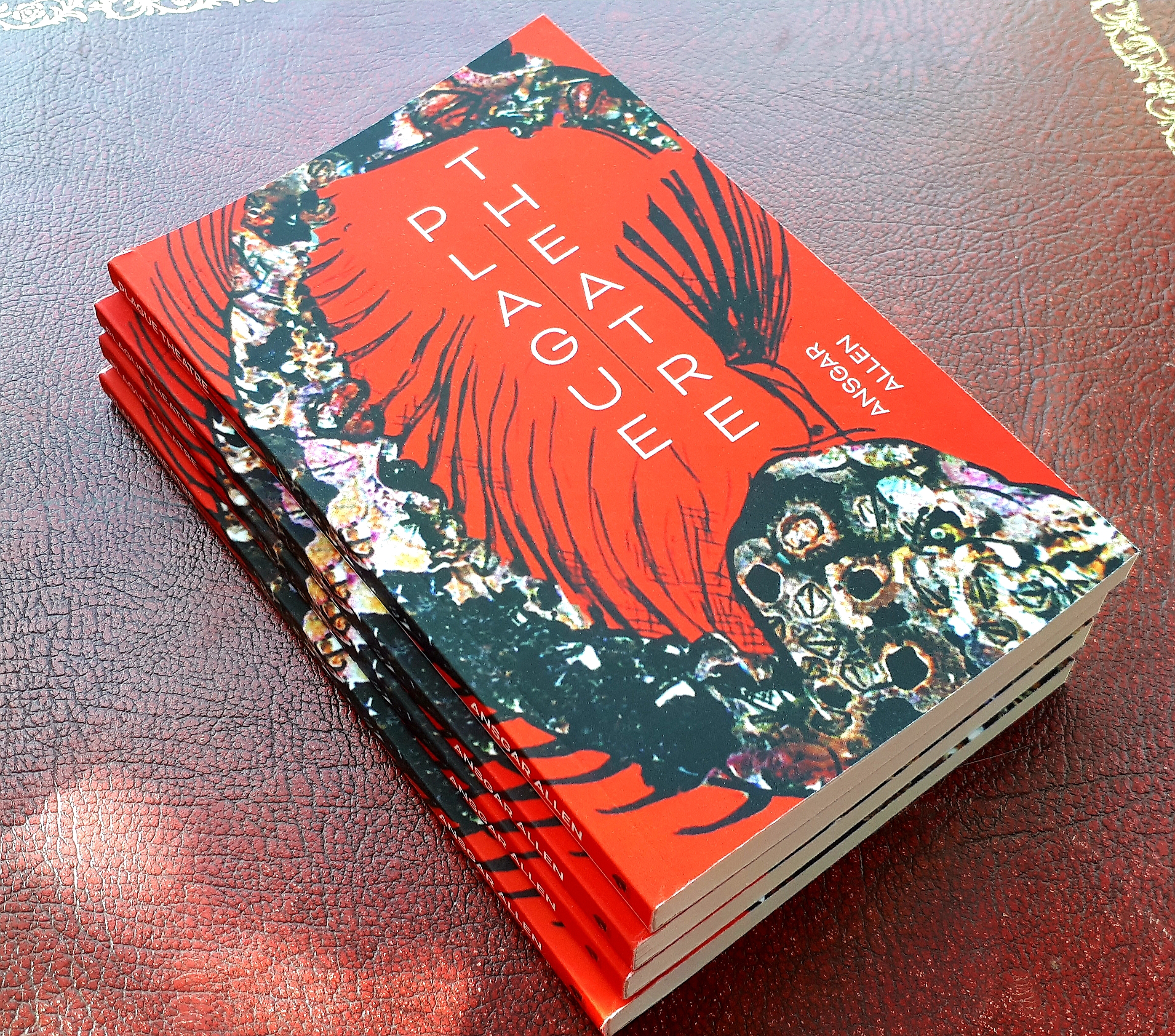
BOOK DESCRIPTION
Set in Scarborough on the north coast of England, Plague Theatre tells of a great derangement which takes hold of the town in or around 1720. No one can tell if it is the body or the mind that has become infected, but what threatens the town risks making the north east uninhabitable.
Plague Theatre is concerned with the plague that is already present in society before the virus, or bacterium, or rat. It offers an extended meditation on Antonin Artaud’s essay ‘Theatre and the Plague’, in which Artaud claims that the pathogenic cause of each plague is secondary, or peripheral before the real calamity which is social. Both plague and theatre achieve, for Artaud, ‘the exteriorization of a latent undercurrent of cruelty’. It is through cruelty which appears as revelation ‘that all the perversity of which the mind is capable, whether in a person or a nation, becomes localized’.
SCARBOROUGH BEFORE THE GREAT PLAGUE OF 1720

REVIEWS
David Vichnar, Erratum Reviews, 26 Sept 2025; Steve Hanson, Manchester Review of Books, 17 Sept 2025; Elijah Young, Equus Press, 15 June 2023; Steve Hanson, Manchester Review of Books, 6 June 2022; D. Harlan Wilson, Goodreads.com, 24 April 2022; Daniel Green, Unbeaten Paths: Issue 5, 9 November 2022.
“Ansgar Allen has quickly become one of my favorite authors. He takes risks and writes well—these things alone are a rarity today. Equal parts informative, entertaining, and aesthetically appealing, Plague Theatre is an excellent introduction to his evolving oeuvre.” — D. Harlan Wilson.
“The excavation and the exhumation are merged here. An early Briton appears, in an early coffin, a hollowed tree, the body as black as Jet. Anyone who has explored the Scarborough and Whitby coastline – I have, and looking for fossils – will know that Jet comes from the remains of the monkey puzzle tree, which has been compressed for millions of years. This is more than a metaphorical device.” — Steve Hanson
“[Ansgar Allen’s] fiction is somewhat reminiscent of the work of Lars Iyer, although while Iyer’s novels take the form of quasi-Platonic dialogues in which the characters talk about philosophical ideas, Allen’s seem more like parables or fables, in which the narrator-protagonist does directly invoke specific books and ideas but which also themselves embody or dramatize the implications of ideas and ways of thinking.” — Daniel Green
“In Plague Theatre Allen stages the societal and intellectual collapse of norms under conditions of disease, isolation, and socio-political upheaval. The book reads like a libretto or ensemble piece: voices fragment, actors cross roles, spectators become performers. The theatrical register serves to expose institutions—and especially educational performance—as spectacles built atop fragile certainties. The framing of course is Artaud’s “Theatre and the Plague” from Theatre and Its Double,treated not as source text but as contaminant: something that destabilises narrative, compels rewriting, and undermines the intellectual apparatus of interpretation. Artaud is not so much quoted or explained; he is absorbed and redeployed as a meta-critical device.” — David Vichnar
BLURBS
“Plague Theatre is a superb book. Ansgar Allen has created a terrarium of decay; a hall of mirrors whose corridors are lined with countless psychomanteums depicting varying stages upon which everything crumbles in reflection of our own supreme annihilation.” — Daniel Beauregard
“Imagine W. G. Sebald and Italo Calvino collaborated to write an autodecaying mystery on the possibilities of something definitive happening in Scarborough, in London, in Caligari, in Marseille, in Camus’ Oran, in anyplace at anytime, and you’ll have some idea of the brilliant, dramaturgically-infused vision of abstracted pestilence that is Plague Theatre. Part phantom exegesis, part metafictional Klein bottle, Ansgar Allen has written a novel about writing, a text about the exhilarating dangers of repetition and of continuity as obsession, as Yersinia pestis. With Artaud’s “Theatre and the Plague” and Defoe’s Journal of the Plague Year as scrambled guidebooks to its multiplicious and provisional somewhere, the reader is left to bob, delirious, like driftwood in the sibylline and necrotic sludge of our stubbornly inconclusive histories. Artaud considered the plague, like theatre, to be “a crisis resolved either by death or cure,” but here we are offered a third way, a non-direction, a resilient sickness, a resolution resistant to completion till the very end (and there is no end).” — Gary J. Shipley
PRAGUE MICROFESTIVAL 2023
TRAILERS
FIRST PRINT RUN

 Ansgar Allen