Educated People
forthcoming 2026 Punctum Books
A two-part critique of the educated person written in collaboration with Roy Goddard published by Risking Education, an imprint of Punctum Books.
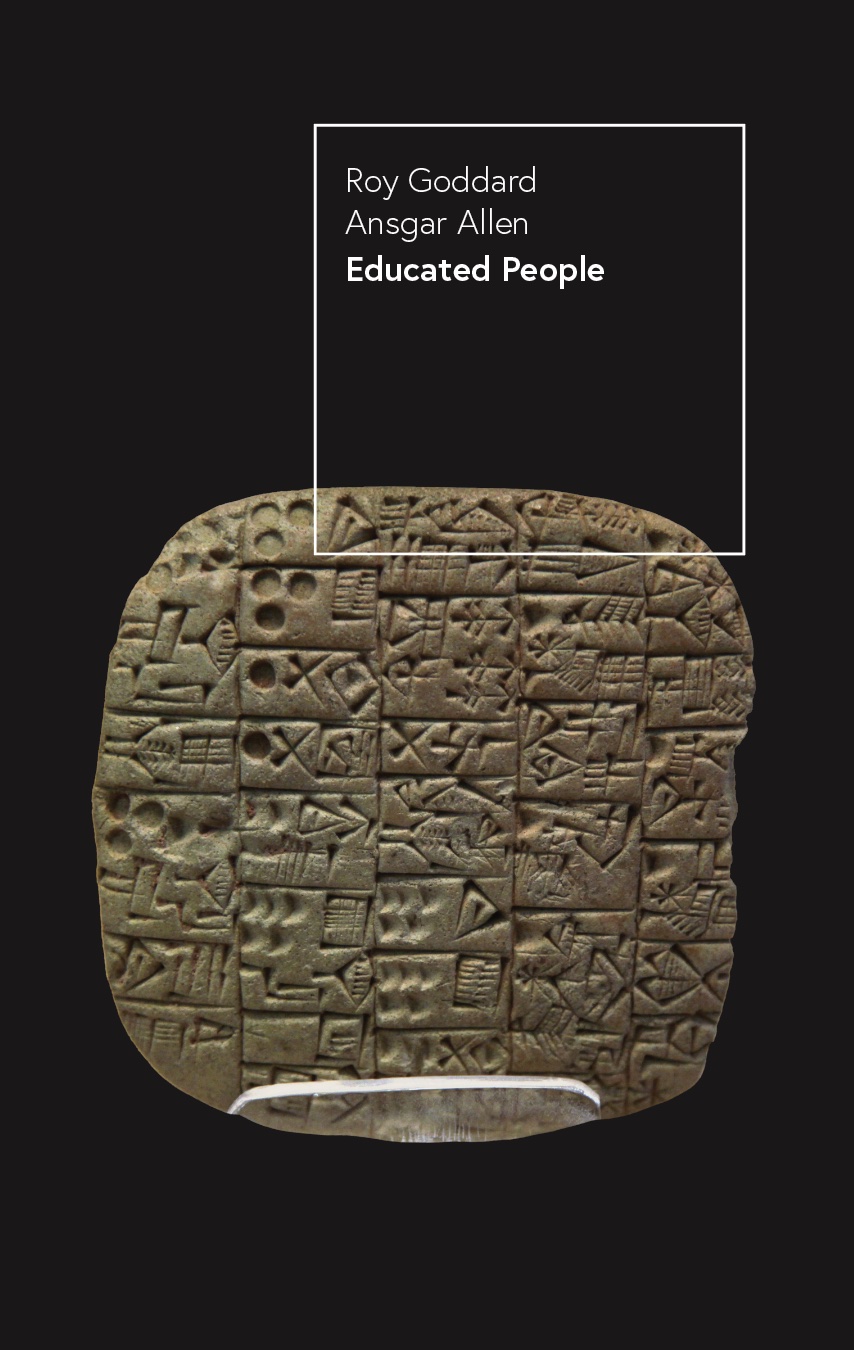
Educated People identifies a spectre haunting the discourse of critical thought and it isn’t communism. It is the unseemly figure of the bourgeois individual, the obscene subject and agent of capitalist culture. This subject is the educated person, the protagonist of a historical culture based on the acceptance of human exploitation and a hypocritical social myopia, whose trajectory tends without shame towards the extinction of social and moral difference and the suppression of humanity’s spontaneous vitality and imagination.
The book recalls from the margins of intellectual history an assortment of radical thinkers who have been deemed useless to the existing imperium of thought, consigned to irrelevance by a system whose grotesque evaluations work relentlessly to reduce human experience to a passive commodity fetishism. The text is written against a dominant academic convention – in which few continue to believe – that conforms to an idea of knowledge as refinable, engaged on progress towards closure, a final and definitive identification of what counts as true. What is presented here is a fragmented text, the product of reading across traditions of philosophy and critique in the arts, history and anthropology, a series of short pieces that often centre on thinkers who have been deemed no longer conformable to a project of closure. These fragments are not so much aphorisms as experiments, tentatively ventured and assembled in such a way as to foster creative doubt, to provoke a more productive sharing and interaction of thought.
BLURBS
“Extraordinarily, and perhaps ironically, erudite, this unfailingly engaging book offers a bracing admixture of cynicism and scepticism, comedy and tragedy, pathos and parody. A raw, unflinching and uncompromising exploration of the conceits of ‘educated people’ and the ways we seek – as a species, as societies and as individuals – to deny, disavow and distance ourselves from our finite, material, animal and embodied existence. The book unfolds via a series of loosely connected paragraphs and sections with little or no attempt to provide an explicit, explicatory grand or overarching narrative for the reader – which suits the book’s persistent troubling of artifice. Perhaps more importantly, the book, brimming with intelligence and insight, offers numerous instances of penetratingly original analysis and acumen, such as the exploration of Canetti’s reflections on hands and their gestures, the kudos afforded by theatres and cinemas, or the musings on the place of the novel. The original and provocative book hits its target, unsettling comfortable and familiar assumptions about what it means to be ‘educated’.” Matthew Clarke, University of Aberdeen
“In spite of itself, perhaps, there is a romance to the work – the romance of walking and intellectual conversation, the preserved aesthetico-intellectual space, the turning of life to art. Perhaps the closest corollary is, in fact, Wordsworth’s (…and Coleridge’s…) The Prelude. It is the playing out of the intellectual relationship/friendship of two ‘educated people’. Their very education (like many of the authors they discuss) providing them with the tools for its self-critique. The educated person is at once presented as obscene, self-obstructive, and unavoidable. Like a lot of good (and I would say almost all great) art, the book cancels itself out; removing its ability to justify itself beyond the experience(s) it makes possible, excepting perhaps its contribution to the development of a ‘form’ of art itself… In some ways it has more in common with Nietzsche’s late notebooks than, say, Beyond Good and Evil. It darts around, following the scent of interest, unburdened by academic ‘permissions’… The necessity of presenting intellectual pursuit in an academic form is undermined both sardonically and romantically; the one fuelling the other. The romance of irony – but no irony in the romance itself. The romance of Educated People is made possible at one and the same time by the lack inherent to education and attachment it nonetheless engenders; both to education itself and to those who can be an (in)sufficient ‘audience’ for the performance and conversation of the educated. Educated People is scathing, charming, devastating and heartwarming. It is a book for those who love education – but in all the ‘wrong’ ways.” — Emile Bojesen, University of Winchester
 Ansgar Allen